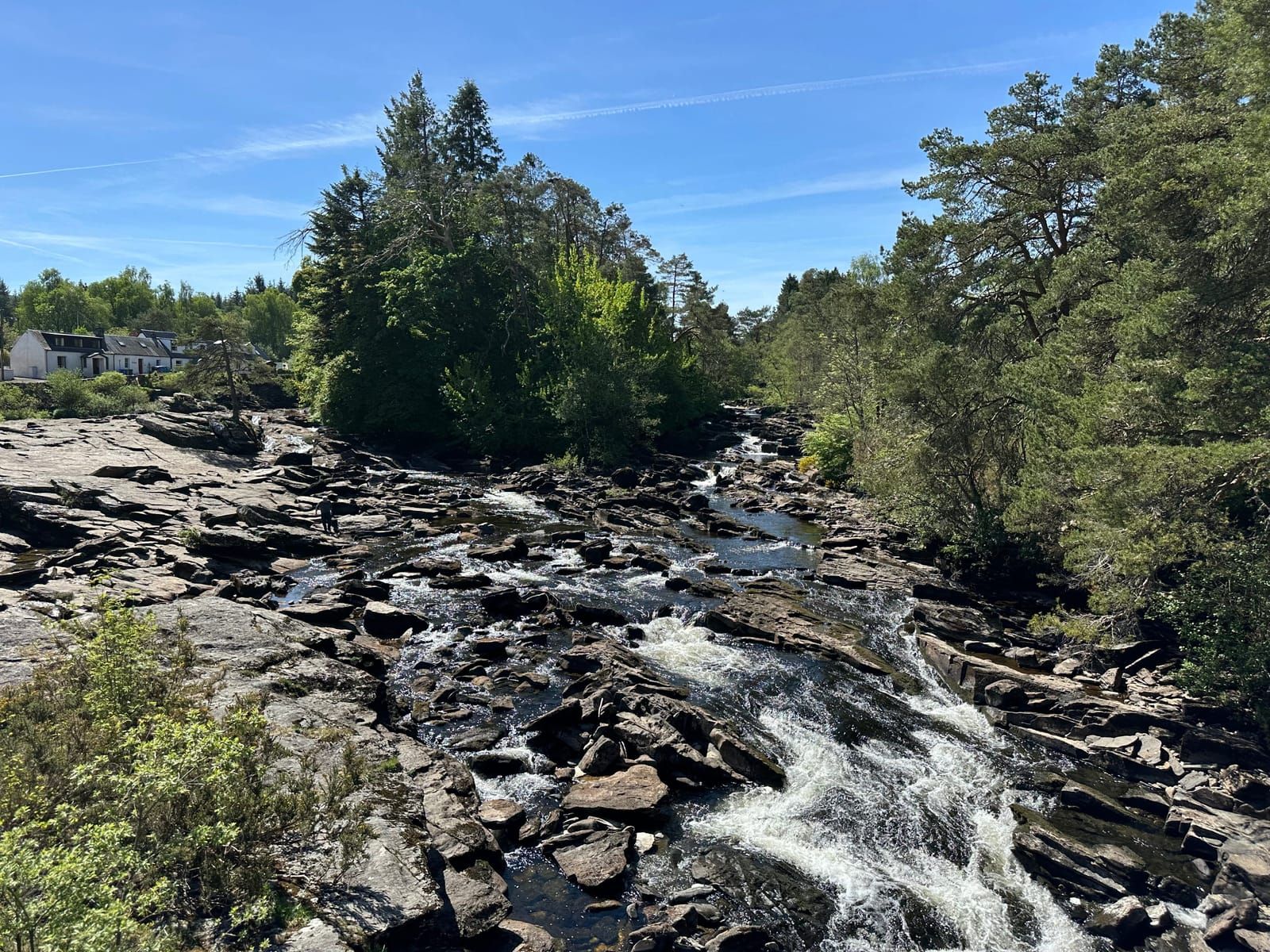
The Falls of Dochart are one of Scotland's most spectacular and accessible waterfalls, cascading through the heart of Killin village at the head of Loch Tay.
The Falls of Dochart are one of Scotland’s most iconic natural sights — and one of its most accessible. Unlike many Highland waterfalls that require a strenuous hike to reach, the Falls of Dochart thunder right through the centre of Killin village, visible from the old stone bridge that carries the main road. They’re free to visit, open 24 hours a day, 365 days a year, and they never disappoint. Whether the river is a raging torrent after autumn storms or a gentle, sun-dappled cascade on a still summer evening, the falls have a mesmerising quality that stops visitors in their tracks — often mid-drive, as they cross the bridge and suddenly realise what’s beneath them.
For many visitors, the Falls of Dochart are their first introduction to the Loch Tay area, and they set the tone perfectly: wild, beautiful, steeped in history, and completely free.
What Are the Falls of Dochart?
The falls are a series of powerful rapids and cascades where the River Dochart rushes over a wide shelf of exposed rock before entering Loch Tay at the western end. Rather than a single vertical drop like many Highland waterfalls, the water fans out across a broad, rocky expanse — creating a constantly shifting pattern of white water, pools, channels, and eddies that stretches across the full width of the river.
The falls span roughly 200 metres of river, with the most dramatic section visible from the old bridge. In the middle of the falls sits Inchbuie (from the Gaelic Innis Buidhe, meaning “yellow island”) — a wooded island that serves as the ancient burial ground of Clan MacNab, one of the area’s most historic Highland clans.
The geological story of the falls begins hundreds of millions of years ago. The rocks over which the river tumbles are Dalradian schists — ancient metamorphic rocks that were formed deep in the Earth’s crust and pushed to the surface by tectonic forces. The differential erosion of these rocks — some harder, some softer — has created the stepped, terraced character of the falls, with the river finding its way through natural channels and over ledges worn smooth by millennia of flowing water.
Geology and Natural History
The Rock
The exposed rock shelf at the Falls of Dochart is part of the Dalradian Supergroup, a sequence of metamorphic rocks that underlies much of the central Highlands. These rocks were originally laid down as sediments on an ancient ocean floor around 600–800 million years ago, then subjected to intense heat and pressure during the Caledonian mountain-building event approximately 470 million years ago.
The result is a complex mix of schists and quartzites that erode at different rates, creating the falls’ characteristic appearance — broad, flat platforms of harder rock separated by channels and pools carved into the softer layers. You can see the folding and banding in the rock clearly when water levels are low, providing a vivid illustration of the immense geological forces that shaped the Scottish Highlands.
The River
The River Dochart drains a large catchment area to the west, including the slopes of Ben More, Stob Binnein, and the hills around Crianlarich. This means the river can rise very rapidly after heavy rainfall in the western mountains — sometimes by several feet within hours. The volume of water passing over the falls varies enormously between a dry summer spell and a major autumn spate, and this variation is a large part of what makes repeat visits so rewarding. You can see the same falls dozens of times and never see exactly the same spectacle twice.
History and Folklore
The Clan MacNab and Inchbuie
The island of Inchbuie has been the burial ground of the chiefs of Clan MacNab for centuries. The MacNabs — whose name derives from the Gaelic Mac an Aba, meaning “son of the abbot” — were one of the ancient clans of Breadalbane, with their origins in the Celtic church. Their traditional seat was at Kinnell House, close to Killin, and Inchbuie was considered sacred ground.
The burial ground on the island contains the graves of MacNab chiefs dating back centuries, though the oldest markers are now weathered and difficult to read. The clan’s history is turbulent and colourful — from medieval feuds with neighbouring clans to near-extinction in the 18th and 19th centuries, and an eventual revival with chiefs emigrating to Canada before the line returned to Scotland.
Visiting Inchbuie feels like stepping back in time. The ancient yew trees, the lichen-covered gravestones, and the constant sound of rushing water on all sides create an atmosphere that is both peaceful and powerfully evocative of Highland history. The island is accessible via a small footbridge from the south bank and is maintained by the Clan MacNab trust. There are information boards explaining the clan’s history.
Folklore and Legend
The Falls of Dochart feature in several local legends. One of the most persistent is the story of Fingal (Fionn mac Cumhaill), the legendary giant-warrior of Celtic mythology, who is said to have leapt across the falls. Various rock formations near the falls have been attributed to Fingal’s activities — a common pattern in Highland folklore, where natural features are explained through mythological narratives.
The falls also have associations with St Fillan, the 8th-century Irish monk who established a religious community in the area. The old mill in Killin — now the Breadalbane Folklore Centre — is dedicated to St Fillan, and the river and falls were considered to have healing properties in the medieval period.
Local tradition holds that the falls are at their most powerful and dramatic during the autumn equinox, when the river is typically in spate and the surrounding trees are turning golden. Whether or not this is consistently true meteorologically, there is no doubt that the falls in full autumn flood, framed by golden and russet foliage, are one of the great natural sights of the Scottish Highlands.
The Bridge Viewpoint
The old stone bridge that carries the A827 road over the River Dochart is the classic viewpoint for the falls and one of the most photographed spots in Perthshire. The bridge dates from the 18th century and offers an elevated, panoramic view of the entire cascade, with Inchbuie in the middle distance and the slopes of the surrounding hills forming the backdrop.
The view from the bridge changes character throughout the day:
- Morning: The falls face roughly east-west, so early morning light catches the water from a low angle, creating sparkle and warmth. This is the best time for photography if you want that golden, atmospheric quality.
- Midday: Overhead light reduces contrast but gives the clearest view of the rock formations and water patterns. Good for understanding the geology of the falls.
- Evening: In summer, the late evening light creates long shadows and a warm glow on the surrounding buildings. The falls take on a softer quality as the light fades.
- After dark: Killin is dark enough for the stars to be visible, and the sound of the falls at night — without the visual distraction — is surprisingly atmospheric.
Be aware that the bridge is narrow and carries traffic. There are pedestrian refuges, but take care when photographing, especially with children. The bridge parapets are low by modern standards.
Best Times to See the Falls
After Heavy Rain
This is when the Falls of Dochart are at their most spectacular — and the spectacle is genuinely awe-inspiring. The river can rise dramatically following heavy rainfall in the western catchment, turning the cascades into a thundering wall of white water that you can feel vibrating through the stone of the bridge beneath your feet. The sound is deafening, spray fills the air, and the sheer volume and power of the water is a humbling reminder of nature’s force.
Autumn and winter storms produce the most dramatic conditions. After a sustained period of heavy rain, the falls can be in full spate for several days, and visitors who time their arrival right are rewarded with a sight that ranks alongside anything in the Highlands.
Summer Low Water
In contrast, prolonged dry spells in summer can reduce the flow dramatically, revealing more of the underlying rock formations and creating a gentler, more intimate scene. The exposed rocks become popular spots for sitting and sunbathing, and adventurous visitors pick their way across the rock shelves to explore channels and pools that are normally submerged. Exercise great caution if doing this — the rocks can be extremely slippery even when they appear dry, and the river can rise quickly if rain falls upstream.
Winter
Winter brings its own drama. The falls rarely freeze completely — the volume of water is too great — but in prolonged cold spells, ice forms on the rocks and in the spray zones, creating beautiful ice formations. Snow on the surrounding hills and bare winter trees give the scene a stark, wild quality that is quite different from the lush summer version.
The Circular Walk from Killin
While many visitors simply view the falls from the bridge and move on, a short circular walk allows you to experience them from multiple angles and explore more of Killin’s surroundings:
Route: Start at the bridge, cross to the south side, and follow the path downstream along the south bank of the river. This gives you a different perspective on the falls, looking upstream towards the bridge and Inchbuie. Cross the small footbridge to Inchbuie to explore the burial ground, then continue along the south bank path, which eventually loops through the village and returns you to the bridge via the main street.
- Distance: Approximately 1.5 km
- Time: 30–45 minutes (more with stops)
- Grade: Easy, though some sections near the river can be uneven
You can extend this by continuing downstream along the river towards Loch Tay, following the path that leads to the point where the Dochart enters the loch — a lovely, quiet spot that most visitors miss entirely.
Connection to the Rob Roy Way
The Falls of Dochart sit directly on the route of the Rob Roy Way, the 79-mile long-distance walking trail that runs from Drymen (near Loch Lomond) to Pitlochry. The trail passes through Killin and crosses the old bridge directly above the falls, making this one of the most dramatic points on the entire route.
Walkers on the Rob Roy Way typically arrive in Killin from the west (via Glen Dochart) and leave heading northeast along Loch Tay’s north shore towards Ardtalnaig and Aberfeldy. The falls provide a natural stopping point and a memorable highlight of the walk. Several accommodation options in Killin cater specifically to Rob Roy Way walkers.
Photography Tips
The Falls of Dochart are one of the most photogenic subjects in Perthshire, and a few tips will help you capture them at their best:
- Slow shutter speed — Use a shutter speed of 1/4 second or longer for that classic silky water effect. You’ll need a tripod or a stable surface (the bridge parapet works well). An ND (neutral density) filter allows slow shutter speeds even in bright daylight.
- The bridge gives you the widest, most classic view, but it can be crowded and the vibration from passing traffic can affect long exposures. Walk downstream for more intimate, original angles.
- Autumn colours — October is the prime time. The trees on Inchbuie turn golden, the birches along the banks glow amber, and the contrast with the white water is spectacular. An overcast day actually works better for autumn colour photography, as it eliminates harsh shadows and saturates the colours.
- Include people for scale — The falls are wider and more powerful than they first appear in photographs, and a human figure gives a sense of the immense scale.
- Explore the south bank — Scramble (carefully) down to water level on the south side for dramatic low-angle shots that show the power and texture of the water close up.
- Telephoto compressions — A longer lens (70–200mm) from downstream compresses the perspective and stacks the cascades, creating a dramatic sense of depth.
- Drone photography — The falls look extraordinary from above, but be aware of drone regulations and the proximity to the road and village buildings. Always fly responsibly and check current rules.
Accessibility
The main viewpoint from the bridge is fully accessible to wheelchair users and pushchairs — you simply walk (or wheel) across the bridge on the pavement. The view from the bridge is the classic view and is genuinely impressive.
A path leads down from the south end of the bridge to the river bank for a closer look, but this is uneven, steep in places, and can be slippery — it is not suitable for wheelchairs or those with significant mobility issues. The footbridge to Inchbuie involves steps and is not wheelchair accessible.
The car park beside the falls is on relatively flat ground, and the walk to the bridge is short and paved.
Nearby Cafes and Refreshments
After exploring the falls, Killin offers several excellent options for warming up with a coffee or refuelling:
- Falls of Dochart Inn — Directly beside the falls, this traditional Highland pub serves good food and has outdoor seating with views of the cascades. It’s the natural post-falls stop and is popular year-round.
- Shutters Restaurant & Coffee Shop — On the main street, serving coffee, cakes, and light meals with legendary home baking.
- The Courie Inn — Killin’s modern gastropub, offering seasonal food and drinks in a welcoming atmosphere.
- The Capercaillie — Traditional pub with hearty food and a great atmosphere.
- MacGregor’s Community Store & Café — Community-owned organic shop and café on Main Street. Great coffee, homemade cakes, and local produce.
The village also has public toilets, the Co-op for supplies, and a petrol station, making it an excellent base for exploring the wider Loch Tay area.
Practical Information
Are the Falls of Dochart free to visit? Yes, completely free and open 24 hours a day, 365 days a year. There is no entrance fee, no barrier, and no restricted hours.
How long should I allow? Most visitors spend 20–45 minutes. Allow an hour or more if you want to explore Inchbuie, walk the river bank, and take photographs from multiple angles.
Are they suitable for children? Absolutely — children are fascinated by the power of the water. However, supervise closely near the water’s edge. The rocks can be extremely slippery, and the currents are powerful.
Can I swim in the falls? It is strongly not recommended. The currents are deceptively powerful, the rocks are hard and unforgiving, and the water is cold. There have been accidents here over the years. For swimming, head to calmer stretches of Loch Tay or the designated swimming spots.
Are dogs allowed? Yes, but keep them on a lead near the water. The currents are strong enough to be dangerous for dogs, and the rocks are slippery.
Is there a visitor centre? Not specifically for the falls, but the Breadalbane Folklore Centre in the old mill building near the bridge provides information about the falls, the MacNab clan, and the history of Killin and the wider area. It’s worth a visit to understand the stories behind what you’re seeing.
The Falls in Context
The Falls of Dochart are more than just a pretty waterfall. They sit at a geographical and historical crossroads — the point where the River Dochart meets Loch Tay, where the western Highlands give way to the Breadalbane heartland, and where ancient clan territories overlapped and sometimes clashed. The falls have been a landmark, a meeting point, a sacred place, and a source of power (the old mill beside the bridge was water-powered) for as long as people have lived in this glen.
Standing on the bridge, watching the water surge over the rocks as it has done for thousands of years, it’s easy to understand why this place has such a hold on people’s imaginations. The Falls of Dochart are one of those places that genuinely exceeds expectations. No matter how many photographs you’ve seen, no matter how many visitor reviews you’ve read, the reality of standing on that bridge with the water roaring below you, the mountains rising beyond, and the ancient burial island sitting serenely in the midst of all that wild energy, is something else entirely. It is, quite simply, one of the great free experiences in Scotland.
Mentioned in this guide
Falls of Dochart Inn
Killin
Killin's iconic pub with a terrace overlooking the famous falls — great food, real ales, and Highland atmosphere.
The Courie Inn
Killin
Stylish boutique accommodation above one of Killin's best restaurants.
Shutters Restaurant & Coffee Shop
Killin
Popular Main Street café in Killin serving light lunches, excellent coffee, and legendary home baking.
The Capercaillie
Killin
A friendly traditional Highland pub in Killin with hearty food, live music, and a warm atmosphere.
Breadalbane Folklore Centre
Killin
Local history museum housed in the historic St Fillan's Mill, telling the stories and legends of the Breadalbane Highlands.
MacGregor's Community Store & Café
Killin
Community-owned organic shop and café in the heart of Killin — local produce, proper coffee, and a genuine Highland welcome.