
Loch Tay is one of Scotland's finest freshwater fishing destinations. From brown trout to salmon, here's everything you need to know about fishing the loch.
Loch Tay has been a prized fishing water for centuries. At 14.5 miles long and up to 150 metres deep, it’s one of Scotland’s largest and deepest freshwater lochs — and its fish populations reflect that scale. The loch sits at the heart of the River Tay system, which is the most prolific Atlantic salmon river in Britain and drains a catchment stretching from Rannoch Moor to the North Sea. Whether you’re a seasoned angler who has fished waters across Scotland, or someone picking up a rod for the first time on a Highland holiday, Loch Tay offers world-class fishing in a setting that is genuinely hard to rival anywhere in Europe.
The fishing here isn’t just about what you catch. It’s about the experience — the early morning mist lifting off the water to reveal Ben Lawers, the distant call of a golden eagle, the ripple of a trout rising in the evening calm. Anglers return to Loch Tay year after year, drawn as much by the landscape and the atmosphere as by the fish themselves.
Species Guide: What Can You Catch?
Atlantic Salmon
Loch Tay is a crucial component of the River Tay system, and Atlantic salmon pass through the loch on their journey upstream to spawning grounds in the upper tributaries. This makes the loch one of Scotland’s premier still-water salmon fisheries.
The Spring Run (February–May): The Tay system is famous for its early-running spring salmon — large, silver fish fresh from the sea that begin entering the system from January. These fish typically reach Loch Tay from February onwards, and the spring fishing can be exceptional. Spring salmon on the Tay system average 10–14 lbs, with fish over 20 lbs not uncommon. The traditional method for spring salmon on the loch is trolling — slowly motoring a boat while trailing lures or mounted minnows at varying depths behind the vessel. Trolling allows you to cover vast areas of water and present your lure at the precise depth where fish are travelling.
The Autumn Run (August–October): The autumn sees a second major influx of salmon, including larger fish heading for the upper spawning tributaries. Autumn fish can be fresh-run and full of fight, or coloured-up fish preparing to spawn. The fishing can be fast and furious in September and early October, with multiple hookups possible on a good day. Catch-and-release is strongly encouraged during the autumn to protect spawning stocks, and many beats enforce mandatory release at this time.
Catch Records: The Tay system has produced legendary salmon over the years. The British rod-caught record — a fish of 64 lbs taken by Georgina Ballantine in 1922 — came from the River Tay downstream of the loch. While fish of that size are exceptionally rare, Loch Tay regularly produces salmon in the high teens and twenties, and every season brings a handful of fish over 25 lbs.
Brown Trout
The mainstay of Loch Tay fishing and the species that draws the largest number of visiting anglers. The loch holds excellent populations of wild brown trout, with fish averaging 1–2 lbs but with the genuine possibility of much larger specimens. Trout over 4 lbs are taken each season, and the occasional fish over 6 lbs provides a realistic target for dedicated anglers.
The traditional method is drifting in a boat while casting a team of wet flies on the wind — a style of fishing known as “loch-style” that originated on waters like Loch Tay and has barely changed in two hundred years. The angler sits in the bow of a drifting boat, casting a team of two or three flies on a short line ahead of the boat’s drift, then working them back through the wave. It’s a method that is both meditative and exciting — long periods of rhythmic casting punctuated by explosive takes from trout hitting the top dropper.
Best flies for Loch Tay trout: Soldier Palmer, Black Pennell, Bibio, Kate McLaren, Clan Chief, Wickham’s Fancy, and the ubiquitous Invicta. Dry fly fishing can be productive during evening hatches in June and July, with sedges and olives being the main interest. Nymph fishing is also effective, particularly in the calmer bays.
Season: 15 March – 6 October. The best months are traditionally May and June, when the water is warming and insect hatches are prolific. There is often a lull in July and August during the warmest weather, before a resurgence in September as the water cools and trout feed hard before winter.
Pike
Loch Tay holds some very large pike, and in recent years the loch has gained a growing reputation among specialist pike anglers. Fish over 20 lbs are caught regularly, specimens over 30 lbs are taken most winters, and there are persistent rumours of fish approaching the 40 lb mark in the loch’s deeper basins.
Pike fishing on Loch Tay is typically best during the cooler months — October through March — when the fish are at their heaviest and most active. Methods include spinning with large lures, dead-baiting from a boat or the bank, and trolling with artificial lures. Wire traces are essential, as pike teeth will cut through monofilament or braid with ease.
The shallow, weedy bays at the western end of the loch near Killin are productive pike territory, as are the drop-offs where shallow water meets the deep central channel. The eastern basin near Kenmore also holds good numbers of pike.
Arctic Char
One of Loch Tay’s lesser-known residents is the Arctic char — a relic species from the last Ice Age that survives in a handful of deep, cold Scottish lochs. Char are beautiful fish with vivid orange-red bellies, and catching one is a rare privilege. They inhabit the deepest parts of the loch, typically below 30 metres, and are most commonly encountered by anglers trolling deep for salmon.
Arctic char are not specifically targeted by most anglers, but their presence is a testament to the loch’s water quality and ecological health. If you do catch one, please handle it carefully and return it quickly — these are a genuinely rare and precious species in a Scottish context.
Methods: Fly Fishing vs Trolling
Fly Fishing
Fly fishing on Loch Tay is primarily aimed at brown trout, though salmon can occasionally be taken on the fly in the shallower sections, particularly near river inflows. The classic loch-style approach uses a 10–11ft rod rated for a 6–7 weight line, with a floating or intermediate line and a team of wet flies. Leaders are typically 10–12 ft with three flies spaced at intervals.
For bank anglers, a longer rod of 11–12ft gives better line control and distance. The most productive bank fishing tends to be in the evenings, when hatching flies draw trout into the shallower margins.
Trolling
Trolling is the dominant method for salmon on the loch, and is also used for pike and occasionally for larger trout. It requires a motor boat (rowing is possible but exhausting over a full day) and specialised tackle including downriggers or lead-core lines to get lures to the correct depth.
A typical trolling setup for salmon uses two to four rods set at varying depths, with lures such as Rapalas, Tobys, or mounted natural minnows trailing 30–50 metres behind the boat. The key is speed control — too fast and salmon won’t follow, too slow and the lures won’t work properly. An experienced ghillie can read the conditions and adjust depth, speed, and lure selection to maximise your chances.
Permits, Regulations & Costs
Fishing on Loch Tay requires a permit. These can be obtained from:
- Local tackle shops — Shops in Killin and Aberfeldy sell day permits and can advise on current conditions
- The Loch Tay Fisheries — The main management body for fishing on the loch
- Hotels and guest houses — Many lochside hotels can arrange permits for guests
- Online booking — Increasingly available through local operator websites
Typical Costs
- Brown trout day permit (boat): £15–30 per rod
- Brown trout day permit (bank): £10–20 per rod
- Salmon trolling permit: £40–80 per rod per day, depending on the beat and time of season
- Boat hire (rowing boat): £30–50 per day
- Motor boat hire: £60–100 per day
- Ghillie service: £150–250 per day (usually covers one or two rods, plus boat and fuel)
Important Regulations
- Catch and release is strongly encouraged for all salmon, and mandatory on many beats during autumn
- Barbless or micro-barbed hooks are recommended across the loch and mandatory on some beats
- No live bait on most beats — dead bait is permitted for pike on some areas
- Bag limits apply for brown trout, typically 4–6 fish per rod per day, with size limits in place
- Check current regulations before fishing — rules can vary between beats and change seasonally
Boat Hire & Ghillie Services
Several operators around the loch hire out fishing boats and provide ghillie services:
- Traditional rowing boats — Ideal for drifting for trout in the classic loch-style manner. Light, responsive, and quiet, they allow you to cover water methodically and fish the most productive drifts.
- Motor boats — Required for trolling for salmon and useful for accessing more distant parts of the loch. Typically 14–16ft with outboard motors.
- Boats with ghillies — An experienced local ghillie is money well spent, especially if you’re new to Loch Tay. They know every drift, every lie, every productive area, and every local method. A good ghillie doesn’t just put you over fish — they share decades of accumulated knowledge about the loch, its ecology, and its history.
Local ghillie services can be arranged through tackle shops, hotels, and fishery offices. Booking well in advance is advisable for peak periods, particularly the spring salmon season and the May–June trout fishing.
Shore Fishing Spots
While boat fishing is the traditional way to fish Loch Tay, bank fishing is productive and accessible, particularly for brown trout and pike:
- Kenmore shores — The eastern end of the loch, with accessible banks and good wading in places. Evening trout fishing here can be excellent, particularly when sedges are hatching.
- Ardeonaig stretch — The south shore around Ardeonaig offers accessible bank fishing with shelving rocky ground that holds feeding trout. Best fished in the evenings or on overcast, breezy days.
- Killin pier area — Easy access and productive for both trout and pike. The shallow western basin is particularly good for pike in winter, with dead-baiting from the bank being the most effective method.
- Lawers and Fearnan — On the north shore, various access points allow bank fishing with excellent views. The deeper water along the north shore means trout can be found closer to the bank than on the shallower south side.
The River Dochart: River Fishing
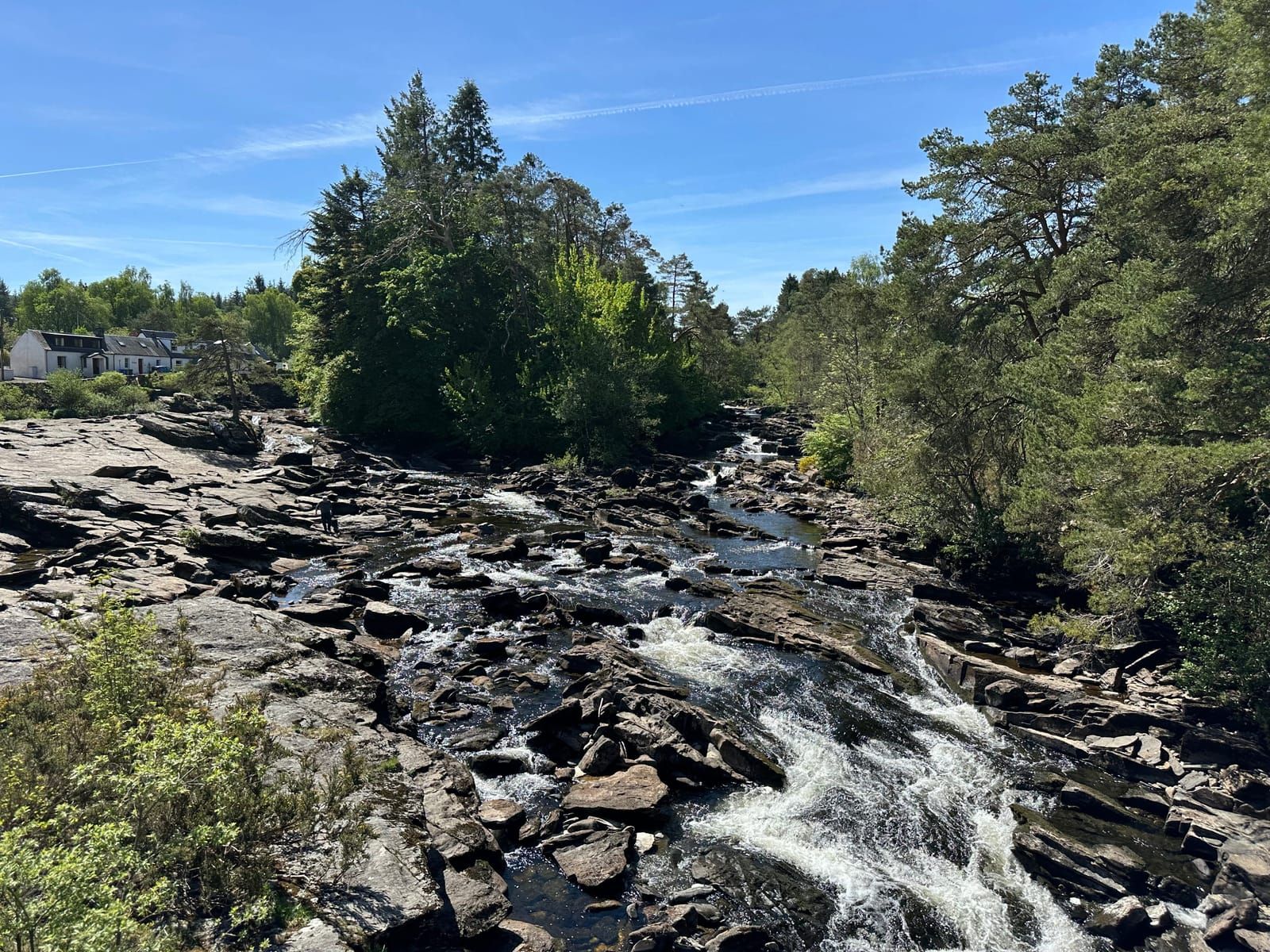
While this guide focuses on loch fishing, the River Dochart — which enters the western end of Loch Tay at Killin after tumbling over the famous Falls of Dochart — offers excellent river fishing and is worth a separate mention.
The Dochart holds salmon, sea trout, and brown trout, with the river fishing being entirely different in character to the loch. Fly fishing is the primary method, using single-handed rods and classic wet fly or nymph techniques. The river has a good head of wild brown trout, and salmon can be caught from spring through autumn as fish pause in the pools below the falls and in the deeper holding pools upstream.
Permits for the River Dochart are available locally, and the fishing is generally less expensive than loch salmon permits. The river is at its best after a spate (a rise in water level following rain), when fresh fish push upstream and resident trout become more active.
Best Seasons by Species
| Species | Peak Months | Method | Notes |
|---|---|---|---|
| Brown Trout | May–June | Fly fishing (boat drift) | Evening rises excellent in June |
| Salmon (spring) | March–May | Trolling | Fresh, silver fish; best after mild winters |
| Salmon (autumn) | Sept–Oct | Trolling | Largest fish; catch-and-release encouraged |
| Pike | Oct–March | Spinning, dead-bait | Biggest fish in deep winter |
| Arctic Char | Year-round | Deep trolling (incidental) | Rare; handle with care and return |
Conservation and Catch-and-Release
Loch Tay’s fishing community takes conservation seriously. The Tay system’s salmon stocks, like those across Scotland, face pressures from changing ocean conditions, river engineering, and predation. Catch-and-release is now the norm rather than the exception for salmon, and the vast majority of anglers voluntarily release their fish.
For brown trout, sensible bag limits and size restrictions ensure that the loch’s wild populations remain healthy. Pike management is an ongoing topic of discussion, with some arguing for population control and others advocating for catch-and-release of all species.
As a visiting angler, the best thing you can do is:
- Use barbless hooks — They make release easier and less harmful to the fish
- Handle fish in the water where possible — Avoid lifting fish from the water for photographs. Use a rubber-mesh landing net.
- Minimise playing time — Land fish as quickly as reasonably possible to reduce exhaustion
- Follow local rules — Regulations exist for good reason. Respect them, even if you disagree.
Tackle Shops and Local Knowledge
Local tackle shops are invaluable sources of up-to-date information on conditions, fly hatches, and which areas are fishing well. They sell permits, recommend flies, and often know what was caught yesterday and on what method. Shops in Killin, Kenmore, and nearby Aberfeldy carry a good range of tackle suitable for Loch Tay fishing.
Don’t underestimate the value of a conversation with the person behind the counter. Five minutes of local knowledge can save you hours of fruitless fishing in the wrong area with the wrong method.
Equipment Guide
Most operators can supply equipment, but if you’re bringing your own:
- Trout (boat): 10–11ft rod, #6–7 line, floating or intermediate. Selection of traditional wet flies in sizes 10–14. Spare leaders and a landing net.
- Trout (bank): 11–12ft rod, #6–7 line, floating. Longer leaders for bank fishing. Chest waders useful but not essential.
- Salmon (trolling): 8–9ft trolling rod, multiplier reel, selection of lures (Rapalas, Tobys, mounted minnows). Lead-core line or downrigger for depth control.
- Salmon (fly): 12–14ft double-handed rod, #9–10 line, selection of salmon flies (Ally’s Shrimp, Cascade, Stoat’s Tail).
- Pike: Heavy spinning rod, large fixed-spool or multiplier reel, wire traces (essential), selection of large lures or dead baits.
The Complete Experience
Loch Tay fishing is about more than just catching fish. The privilege of being on this beautiful water at dawn, with golden eagles circling overhead, red deer picking their way along the hillside, and the surface of the loch dimpling with rising trout, is an experience that stays with you whether you land a fish or not. Many anglers describe their days on Loch Tay as among the most rewarding of their fishing lives — not necessarily for the size of the catch, but for the quality of the setting and the deep sense of connection with a landscape that has drawn fishermen for thousands of years.
Book a ghillie, hire a boat, and give yourself a full day. There are few finer ways to spend time in the Scottish Highlands.