Monty Python fought the Killer Rabbit here. James Bond's house was here. Robert Burns scribbled on a hotel wall. Pontius Pilate may — just may — have been born here. Loch Tay's cultural footprint is far bigger than most visitors realise.
Most people come to Loch Tay for the mountains, the water, and the whisky. But this quiet corner of Perthshire has an outsized cultural footprint that stretches from Bronze Age mythology to 1960s Hollywood — and takes in one of the greatest comedy films ever made along the way.
Here’s a guide to the films, books, music, and legends that have Loch Tay at their heart.
Monty Python and the Holy Grail (1975)
The most beloved comedy in British cinema history has a direct connection to the south shore of Loch Tay. The Cave of Caerbannog — home of the terrifying Killer Rabbit — is actually an abandoned 19th-century copper mine that once belonged to the 2nd Marquis of Breadalbane. It sits roughly midway along the south side of the loch, accessible only by a scramble through the woods.
The nearby hovel, where King Arthur and his knights first encounter Tim the Enchanter (John Cleese at his most gloriously unhinged), was also filmed on the south shore.
The locations are so remote and unmarked that when Michael Palin and Terry Jones returned in 2001 to film a documentary for the Special Edition DVD, they had considerable trouble finding the cave again. It remains one of Scotland’s great hidden film locations — no signpost, no car park, no gift shop. Just a dark opening in the hillside above the loch, where Tim once warned of “a foul, cruel, and bad-tempered rodent.”
“That rabbit’s dynamite!” — Tim the Enchanter
If you’re driving the south Loch Tay road between Kenmore and Killin, keep your eyes peeled around the midpoint. The cave is there, somewhere in the trees above the road. Finding it is half the adventure.
Watch: Monty Python and the Holy Grail is available on most streaming platforms. The 2001 documentary Monty Python and the Holy Grail in Lego and the location retrospective are on the Special Edition DVD.
Casino Royale (1967)
Before Daniel Craig emerged from the sea, before even Sean Connery raised an eyebrow, there was the other Casino Royale — the gloriously chaotic 1967 spoof starring Peter Sellers, David Niven, Ursula Andress, and Orson Welles.
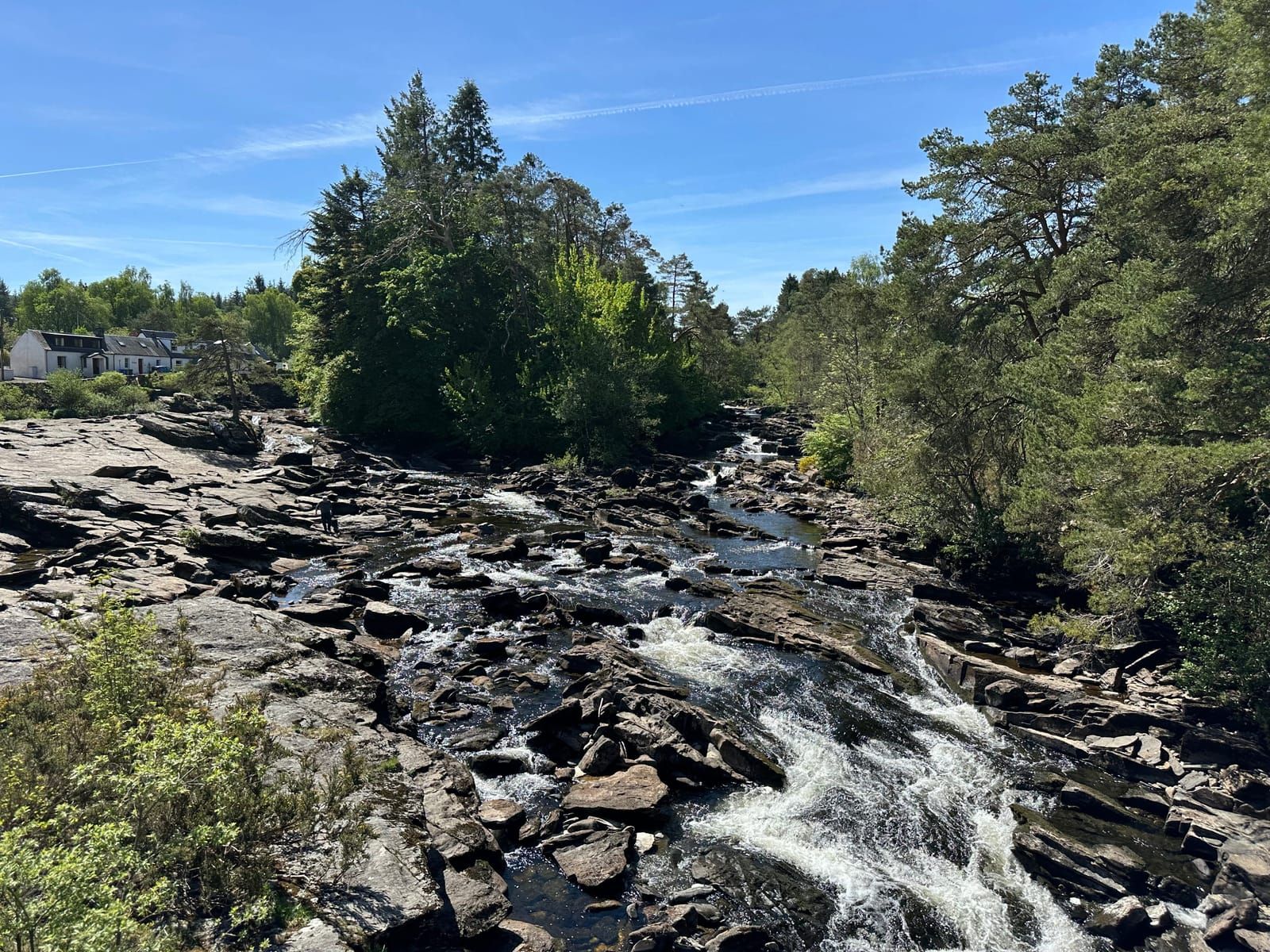
The film’s Scottish scenes were shot at Killin, with the Falls of Dochart and the adjacent bridge doubling as the approach to Sir James Bond’s Highland retreat. The production was directed (in part) by the great John Huston, who worked with the cast in Scotland amid a famously troubled shoot that ran massively over budget.
Peter Sellers and Orson Welles reportedly couldn’t stand each other and refused to be in the same room — which gives the Scottish location footage a certain poignancy, as it represents one of the few sequences where the film actually holds together.
The falls are as dramatic today as they were in 1967. Stand on the bridge, look upstream, and you’re seeing essentially the same view that the camera captured sixty years ago.
Buy: Casino Royale (1967) on Amazon
The 39 Steps (1959)
John Buchan’s classic 1915 thriller has been adapted many times, but the 1959 version — starring Kenneth More and directed by Ralph Thomas — was the first to be shot extensively on location in Scotland, rather than in a studio. Filming began in September 1958, and the crew used locations across the Trossachs and Perthshire, including the Falls of Dochart in Killin.
A scene of Hannay talking to a shepherd was filmed beside the falls and the old stone bridge — the same bridge that appears in Casino Royale eight years later. Killin’s falls were clearly a favourite of Scottish location scouts in the late 1950s and ’60s, and it’s easy to see why. The combination of dramatic water, ancient stonework, and mountain backdrop is the platonic ideal of “wild Scotland.”
The 1959 film also shot at the Forth Rail Bridge, Loch Lubnaig, and the Duke’s Pass in the Trossachs, but the Killin footage captures the Highland atmosphere perfectly.
Read: The Thirty-Nine Steps by John Buchan (1915) — Available on Amazon. The novel is set partly in the Scottish Highlands, though Buchan’s descriptions are deliberately vague about the exact location. Perthshire claims fit perfectly.
Robert Burns at the Kenmore Hotel (1787)
In 1787, Robert Burns — Scotland’s national poet — visited Loch Tay during his Highland tour and stayed at the Kenmore Hotel, which had already been standing for over two hundred years (it was built in 1572 and is reputed to be Scotland’s oldest hotel).
Burns was so moved by the view from his room — the loch stretching westward towards the mountains, the ancient trees of the Taymouth estate reflected in the water — that he wrote a poem directly onto the plaster wall above the fireplace. The poem, often called the “Kenmore Poem” or “The Admirable Crichton,” reads:
Th’ admiring stranger’s eye, The seemingly uplifted high, The lawns wood-fring’d in Nature’s native taste, The hillocks dropt in Nature’s careless haste, The arches striding o’er the new-born stream, The village glittering in the noontide beam—
The poem is still there. You can see it at the Kenmore Hotel, preserved under glass, in Burns’s own handwriting. It’s a remarkable thing — one of Scotland’s greatest poets, scribbling on a wall in a moment of genuine awe, and the wall surviving for nearly 250 years.
Burns went on to describe the area as one of the most beautiful he had seen in Scotland. Coming from a man who had seen a great deal of Scotland, that’s a considerable endorsement.
Visit: The poem is displayed in the bar at the Kenmore Hotel. You can see it while enjoying a dram — which is, frankly, exactly what Burns would have wanted.
Queen Victoria at Taymouth Castle (1842)
In September 1842, a young Queen Victoria and Prince Albert visited Taymouth Castle near Kenmore, the spectacular neo-Gothic seat of the Campbells of Breadalbane. It was Victoria’s first visit to the Highlands, and the reception was extraordinary — bonfires blazed on the hilltops, Highland warriors lined the drive, pipers played, and the castle itself was illuminated by thousands of candles.
Victoria was enchanted. She wrote in her journal:
“The firing of the guns, the ## cheering of the great crowd, the picturesque-ness of the dresses, the beauty of the surrounding country, with its rich background of wooded hills, altogether formed one of the finest scenes imaginable.”
The visit is credited with sparking Victoria’s lifelong love affair with the Highlands, which would eventually lead to the purchase of Balmoral and the Victorian romanticisation of Scotland that shaped tourism, tartan, and Highland culture for the next two centuries. In a very real sense, Loch Tay lit the fuse for the modern Scottish tourism industry.
Taymouth Castle is currently undergoing restoration, but the grounds and surrounding area are atmospheric and walkable.
The Fortingall Yew — 5,000 Years of Legend
In the churchyard at Fortingall, a few miles from the eastern end of Loch Tay, stands one of the oldest living things in Europe. The Fortingall Yew is estimated to be around 5,000 years old — which means it was already ancient when the Egyptians built the pyramids.
The tree was once enormous. In 1769, its girth was measured at 52 feet. Since then, the trunk has decayed and split into several separate stems, but the tree remains in good health, protected by a low stone wall erected in 1785 to prevent Victorian souvenir-hunters from hacking off pieces.
The Fortingall Yew is layered with myth. The most persistent legend claims that Pontius Pilate was born in its shade, supposedly the son of a Roman envoy who visited the area. Historians have thoroughly debunked this — Pilate was born in Roman territory well before the legions reached Scotland — but the legend endures, and you can see why. There’s something about standing beside a tree that has been alive for five millennia that makes even the most outlandish stories feel plausible.
More credibly, archaeologists believe the tree was the focus of an Iron Age sacred site, and that the early Christian church was deliberately built beside it because the location was already considered holy. The yew has outlived every religion, every empire, and every civilisation that has stood before it.
Visit: The Fortingall Yew is free to visit and accessible year-round. The village of Fortingall itself is one of the prettiest in Perthshire.
The Loch Tay Boat Song
The Loch Tay Boat Song (Iorram Loch Tatha in Scottish Gaelic) is one of the most haunting traditional Scottish songs. It tells of unrequited love on the loch, with the singer rowing across the water toward a red-haired girl (nighean ruadh) who does not return their affection. The refrain — “Horo, my nut-brown maiden” — is one of those melodies that, once heard on a still evening by the loch, never quite leaves you.
The song references Ben Lawers, Killin, and Aberfeldy by name, placing it firmly in the Loch Tay landscape. It was popularised in the folk revival era by Silly Wizard (on their album Kiss the Tears Away) and has been recorded by The Corries, Dougie MacLean, and numerous other Scottish folk artists.
If you’re driving the loch road on a quiet evening with the windows down and a folk playlist on, this is the song you want to hear as the light fades on Ben Lawers.
Listen: The Corries — Loch Tay Boat Song on YouTube
The Crannogs — 2,500 Years of Loch Life
At least 18 ancient crannogs — artificial islands supporting timber roundhouses — have been discovered beneath the waters of Loch Tay. The best-studied, the Oakbank Crannog, dates to around 500 BC and was discovered by University of Edinburgh archaeologists in 1979. It’s one of the most important Iron Age sites in Britain.
The Scottish Crannog Centre near Kenmore is a faithful reconstruction of an Iron Age loch dwelling, built using the same techniques and materials as the originals — alder wood, hazel wattle, and reed thatch. Stepping inside is a genuinely moving experience: you’re standing in a space that people called home two and a half thousand years ago, on a loch that has barely changed.
What makes the crannog story remarkable is the scale. Eighteen crannogs on one loch suggests a thriving, interconnected community living on the water for centuries. Loch Tay was not a wilderness — it was a neighbourhood.
Visit: The Scottish Crannog Centre is open seasonally and runs demonstrations of Iron Age crafts and cooking.
Clan Country — MacNabs, MacGregors, and the Campbells of Breadalbane
The land around Loch Tay has been fought over for centuries. The MacNab clan held territory around Killin from medieval times, their burial island — Inchbuie — visible in the River Dochart just above the Falls of Dochart. You can still see it from the bridge, a small green island with ancient trees, once the sacred burial ground of clan chiefs.
The MacGregors, Menzies, Drummonds, and Robertsons all owned land around the loch. But it was the Glenorchy Campbells — later the Earls and Marquesses of Breadalbane — who came to dominate the region from the 15th century onwards. At the height of their power, the Campbells of Breadalbane controlled an estate stretching from the east coast almost to the west, and their seat at Taymouth Castle was one of the grandest in Scotland.
The clan period left its mark everywhere: in the ruined castles at Lawers and Carwhin, in the place names (Breadalbane itself comes from the Gaelic Bràghad Albainn, meaning “the upper part of Scotland”), and in the stories that locals still tell. This is a landscape that carries its history lightly, but deeply.
Further Reading & Watching
For those who want to dig deeper into the area’s cultural heritage:
- Books:
- The Thirty-Nine Steps by John Buchan — Amazon
- Old Killin & Loch Tay (Stenlake Publishing) — Scottish Bookstore
- The Drove Roads of Scotland by A.R.B. Haldane — a classic account of the cattle-driving routes that passed through Breadalbane
- Mountaineering in Scotland by W.H. Murray — includes vivid accounts of winter climbing in the Ben Lawers range
- The Living Mountain by Nan Shepherd — not about Loch Tay specifically, but the finest book ever written about the Scottish mountains
- Films:
- Monty Python and the Holy Grail (1975) — Loch Tay south shore
- Casino Royale (1967) — Falls of Dochart, Killin
- The 39 Steps (1959) — Falls of Dochart, Killin
- Music:
- Loch Tay Boat Song — The Corries, Silly Wizard
- Caledonia by Dougie MacLean — written not far from Loch Tay
- Loch Lomond — a traditional song, but the sentiment applies
- Websites:
- Scotland the Movie — comprehensive guide to Scottish film locations
- Munro Moonwalker — Alan Rowan’s superb mountain blog, with entries on Ben Lawers and the surrounding hills
This isn’t a comprehensive list — it couldn’t be. Loch Tay has been inspiring writers, filmmakers, musicians, and storytellers for thousands of years, and it shows no sign of stopping. Come for the scenery, stay for the stories.
Mentioned in this guide
Scottish Crannog Centre
Kenmore
Award-winning open-air museum with a reconstructed Iron Age crannog on Loch Tay — one of Scotland's best heritage experiences.
Kenmore Hotel
Kenmore
Scotland's oldest inn, established in 1572, with beautiful lochside setting and excellent dining.
Taymouth Castle
Kenmore
Grand Gothic Revival castle built for the Campbells of Breadalbane — currently being developed as a luxury hotel, with grounds occasionally accessible.
Fortingall Yew
Fortingall
One of the oldest living things in Europe — an ancient yew tree estimated at 3,000–5,000 years old, in the peaceful Fortingall churchyard.
MacGregor's Community Store & Café
Killin
Community-owned organic shop and café in the heart of Killin — local produce, proper coffee, and a genuine Highland welcome.