Killin to Loch Tay Shore
A gentle lochside walk from Killin to the shores of Loch Tay, with beautiful views across the water to the southern hills.
Popular guides
More outdoors
Find by type
Our favourites
Makers & artisans
Shops & local produce
Moderate walk
A beautiful low-level walk along the quiet single-track road on Loch Tay's southern shore, passing through ancient woodland, lochside bays, and the enchanting Acharn Forest.
Distance
12 km
Duration
3-4 hours
Ascent
150m
Route type
linear
Parking
Small parking area at Ardeonaig church
The south shore of Loch Tay is one of the great hidden treasures of Highland Perthshire. While the busy A827 carries traffic along the northern side, the single-track road on the southern shore is a world apart — a quiet, winding ribbon of tarmac and gravel threading through ancient oakwoods, past tiny hamlets, and along rocky shorelines where the only sounds are birdsong and the lapping of water. This linear walk from Ardeonaig to Acharn is the finest section, offering a consistently beautiful low-level route that works wonderfully in any season.
The walk begins at Ardeonaig, a scattered township roughly halfway along the south shore of Loch Tay. There is limited parking near the old church and at a couple of informal lay-bys. The Ardeonaig Hotel — a charming lochside inn — makes a fine starting or finishing point if you are combining the walk with lunch or an overnight stay.
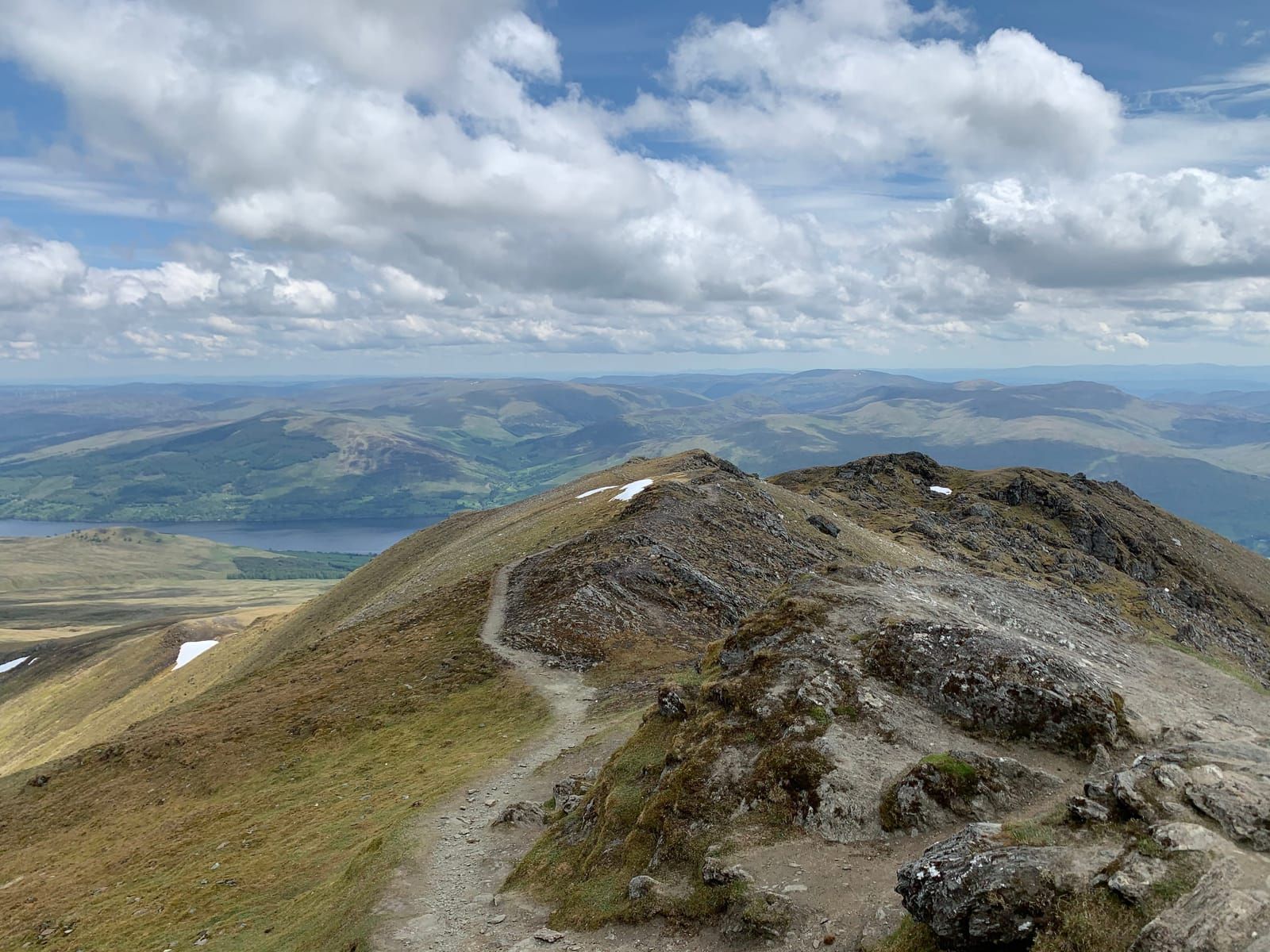
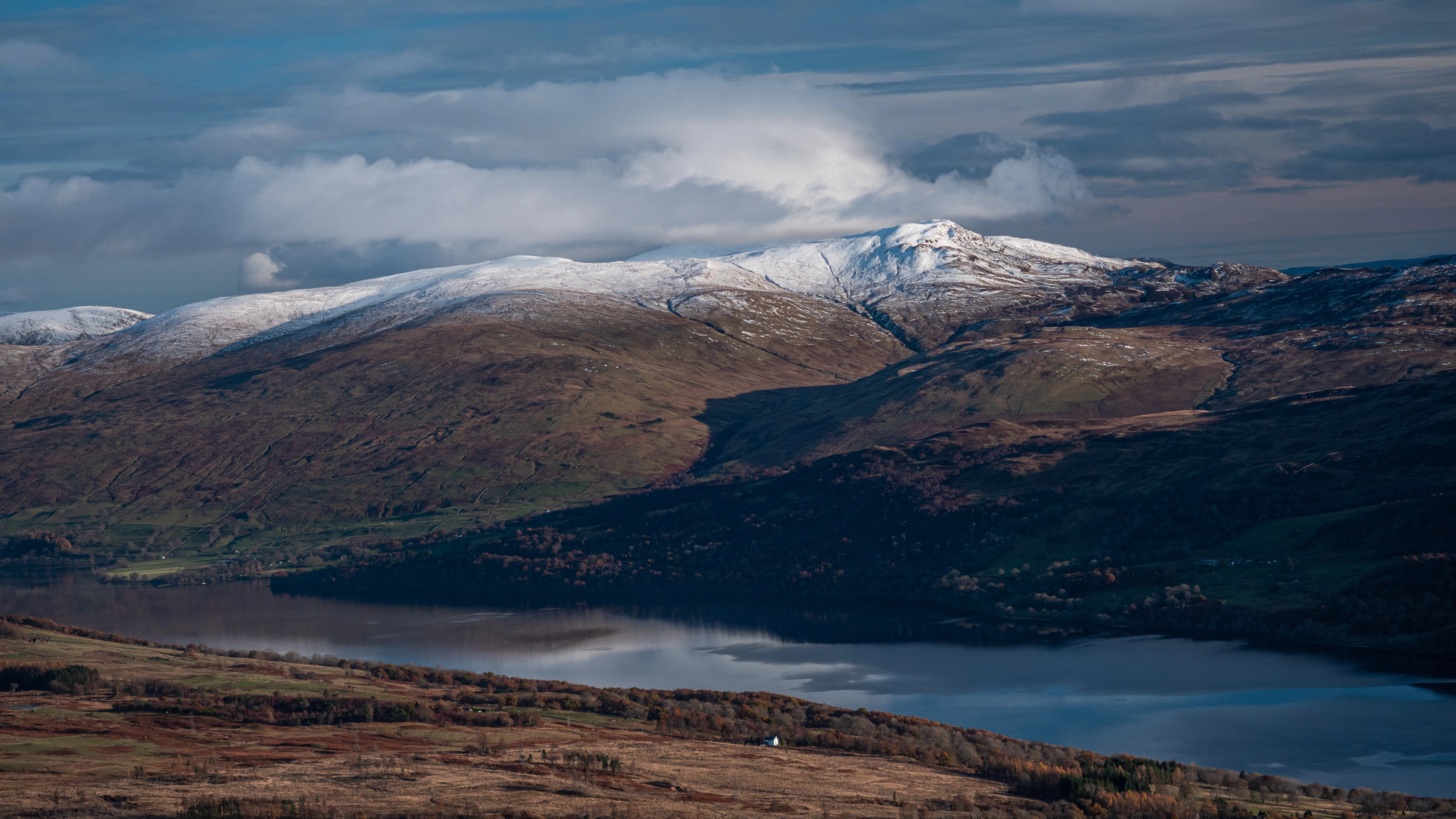
From Ardeonaig, the road heads east toward Acharn, hugging the southern shore. The first section passes through open grazing land with expansive views across the loch to the north shore villages and, beyond them, the towering Lawers range. On a calm morning, the mountains reflect perfectly in the loch’s surface, and the scene is one of extraordinary tranquillity.
The road is single-track with passing places, and traffic is very light — you may see half a dozen cars in an hour. Nevertheless, stay alert on corners and walk facing oncoming traffic where possible.
After roughly 2 km, the character of the walk changes as the road enters a stretch of ancient Atlantic oakwood. These gnarled, lichen-draped trees are remnants of the Caledonian forest that once covered much of the Highlands. The oak, birch, rowan, and hazel create a dappled canopy overhead, and the ground beneath is rich with ferns, mosses, and wood anemones in spring.
This woodland is a haven for wildlife. Listen for the distinctive song of the wood warbler — a cascading, silvery trill that is one of the great sounds of a Scottish spring. Treecreepers spiral up the oak trunks, great spotted woodpeckers drum in the canopy, and red squirrels are regularly spotted here. In the quieter stretches, roe deer may be grazing at the woodland edge, freezing momentarily before bounding away into the undergrowth.
The loch is never far away. Side paths and informal tracks lead down to rocky bays and shingle beaches where you can sit and watch the water. In summer, these sheltered spots are perfect for a paddle or a swim — though the water is always bracing, rarely climbing above 16°C even in August.
Between the woodland sections, the road passes through more open ground with meadows running down to the loch shore. Small bays and inlets indent the coastline, each with its own character. Some have tiny shingle beaches backed by birch trees; others are rocky platforms where grey wagtails bob and dippers work the shallow water.
Keep an eye on the loch itself. Ospreys fish Loch Tay during the summer months (April to September), and there is nothing quite like watching one hover, fold its wings, and plunge feet-first into the water. Grey herons stand sentinel in the shallows, and fleets of goldeneye ducks bob on the water in winter and spring.
At various points, you will pass the remains of old townships — clusters of ruined stone buildings that speak of the Clearances and the long history of human settlement along these shores. Some are barely visible, just tumbled walls among the bracken, but they add a poignant historical layer to the walk.
As you near Acharn, the landscape becomes a little more varied. The road climbs gently through mixed woodland before dropping back to loch level. The village of Acharn is a small, pretty settlement nestled in a wooded glen on the south shore.
Just before the village, look for the signed path leading south into the Acharn Forest. This short detour (add roughly 30 minutes) is very much worth taking.
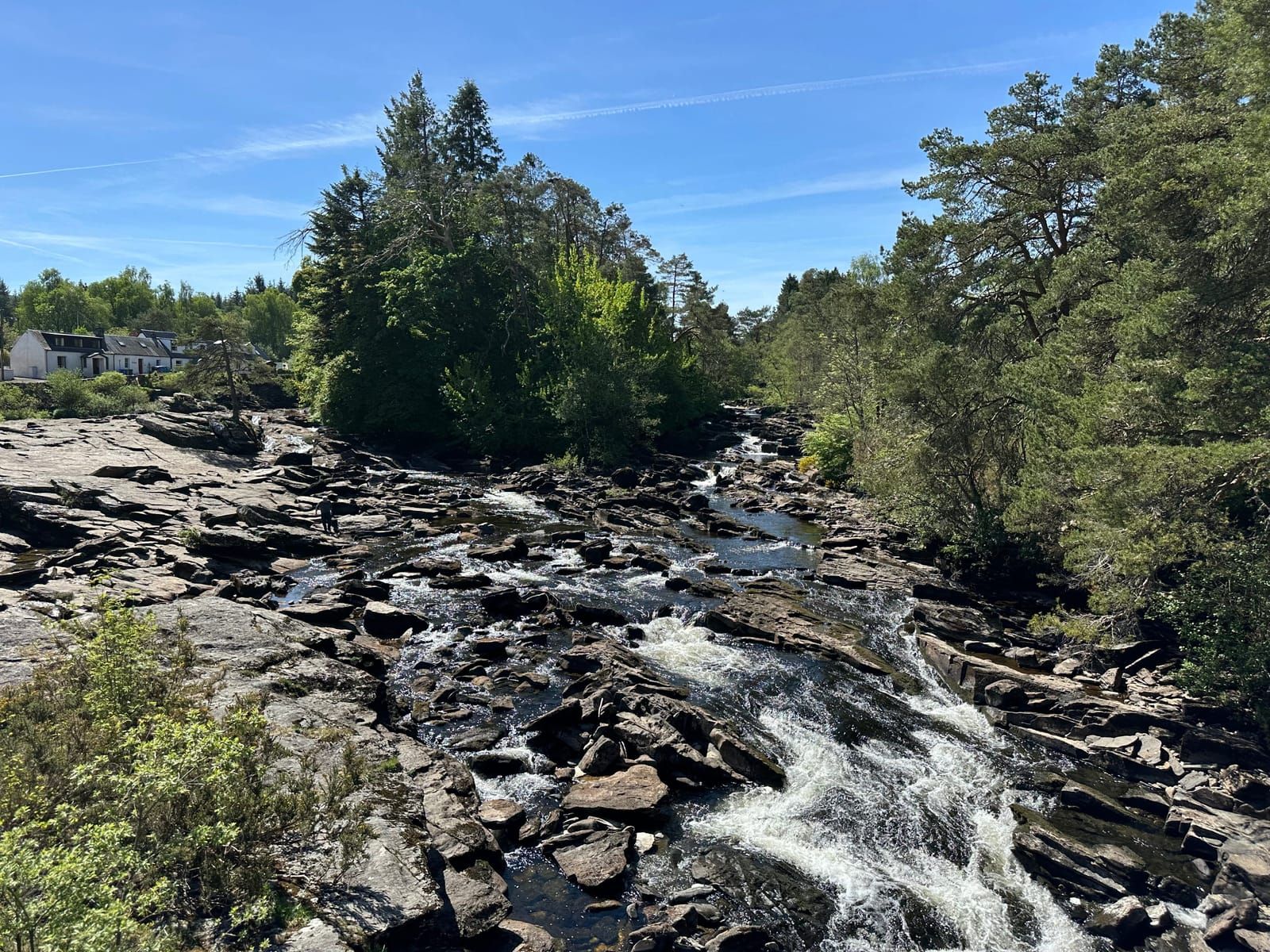
The path climbs steeply through mixed woodland — oak, birch, larch, and Scots pine — following the Acharn Burn upstream. The burn tumbles through a narrow, rocky gorge, dropping over a series of small waterfalls that are especially impressive after rain.
After about 500 metres, you reach the hermit’s cave — a natural rock overhang that was enlarged and embellished in the 18th century as a “romantic” feature by the local laird. A viewing platform allows you to look out through the falls, with the water cascading in front of you. It is a theatrical, slightly surreal experience — a fragment of Georgian-era landscape design hidden in a Highland glen.
Above the cave, a circular path loops through the upper forest before returning to the village. The whole detour is well-signed and well-maintained, though the path is steep and can be slippery when wet.
The south Loch Tay road is one of the best low-level wildlife walks in the area:
This is a linear walk, so you will need to arrange transport at one or both ends. Options include:
This walk is suitable for well-behaved dogs kept on leads (there is livestock in fields along the way). It is also suitable for older children who are happy walking 12 km on road and path. The Acharn Forest section is steep and not suitable for pushchairs.
More walks
New guides, seasonal tips, and the odd hidden gem — straight to your inbox. No spam.
We respect your privacy. Unsubscribe anytime.